
One biological target.
Distinct therapeutic strategies.
Our goal is to translate the therapeutic potential of WASp modulation into medicines for patients with diseases where new mechanisms of action are needed.
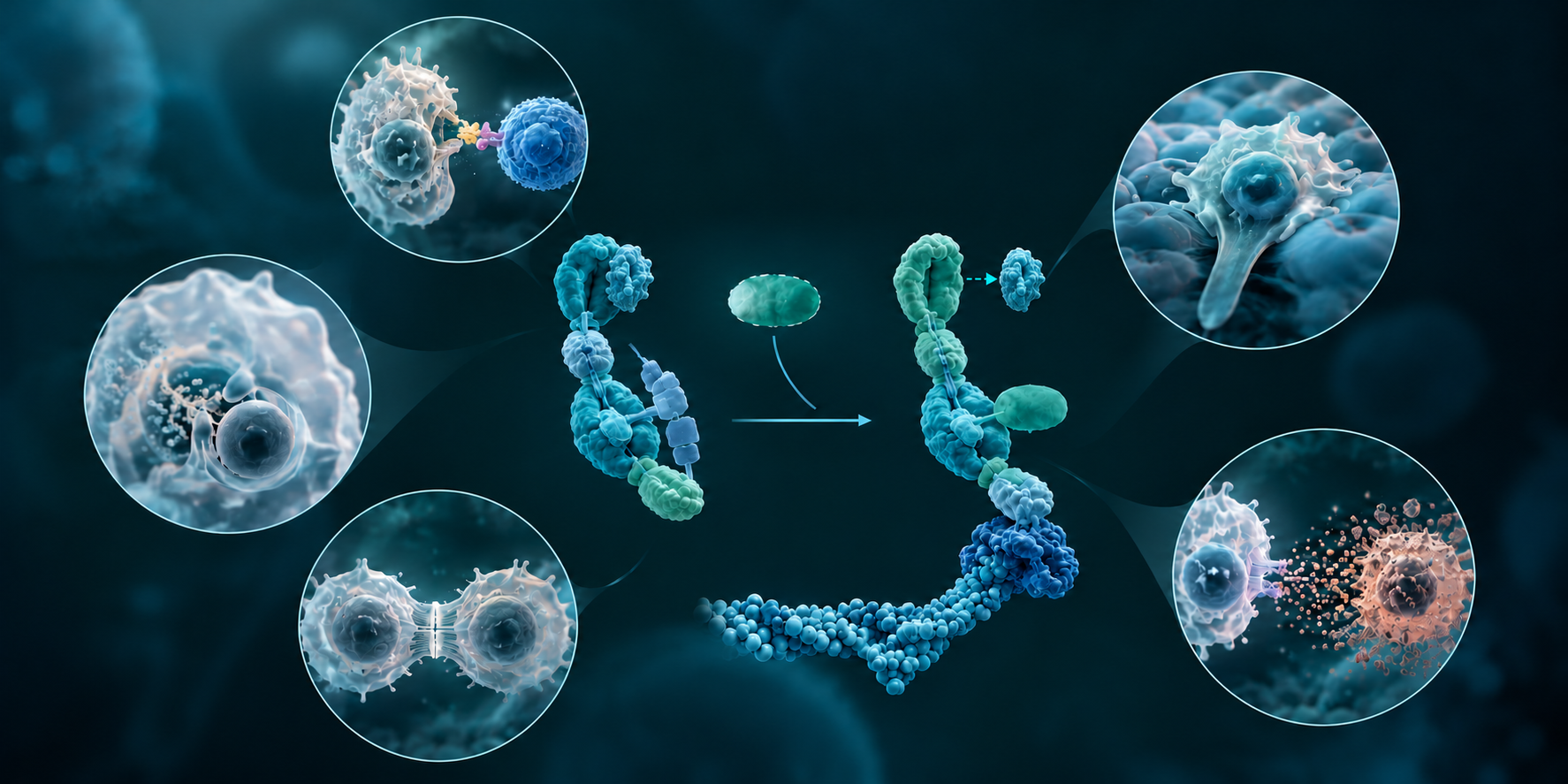
WASp is a cytosolic protein expressed only in non-erythroid hematopoietic cells. It regulates the cytoskeleton of immune cells by actin filament organisation through the Arp2/3 complex and plays an important role in immune cell migration, proliferation, signalling, cytotoxicity and phagocytosis.
The therapeutic potential of WASp modulation depends on the functional role of WASp and the dependency of specific cells on WASp-mediated processes within a particular disease context. BIMINI therefore pursues functional enhancement and functional suppression as complementary strategies arising from the same underlying biology.
BM-011 series | Small-molecule WASp activators | Oncology
Harnessing WASp as a molecular switch to trigger specific cellular responses, including apoptosis in cancer cells.
In selected hematologic cancers, BIMINI is developing small molecules designed to disrupt WASp activity in those cancer cells that are highly dependent on WASp. Our activator compounds increase actin polymerisation and disrupt normal cytoskeletal regulation. In WASp-dependent cancer cells, this can lead to genomic instability and apoptosis.
The programme originated from a phenotypic screen in blood cancers. Subsequent target identification work identified WASp as the molecular target. This work builds on pioneering research from the group of Prof. Francesco Bertoni at the Institute of Oncology Research (IOR), Switzerland. BIMINI has since undertaken a systematic hit-to-lead and lead optimisation programme to improve potency and pharmacokinetic properties while maintaining activity against responder cancer cell lines.
What differentiates the approach
- First-in-class activation of WASp as a therapeutic mechanism.
- A mechanistically distinct approach to hematologic cancer compared to approved drugs.
- Potent activity demonstrated across multiple leukemia and lymphoma models (both in vitro and in vivo).
- No off-target kinase binding identified in kinase profiling of the lead series.
- Potential for development as monotherapy or in combination with established AML therapies (as shown by strong synergy).
Scientific publications
The pioneering research of Prof. Francesco Bertoni’s group at the Institute of Oncology Research, Switzerland, provides published scientific background for the WASp Functional Enhancement strategy.
Spriano F, et al. A first-in-class Wiskott-Aldrich syndrome protein activator with antitumor activity in hematologic cancers.
Our strategy has independently been validated in Science Translational Medicine by the group of Cheng et al. Showing that pharmacological activation of WASp potentiates macrophage phagocytosis and enhances ibrutinib efficacy against mouse models of brain tumors. Sci Transl Med. 2026 Apr 8;18(844):eaed1155. doi: 10.1126
Cheng et al., Pharmacological activation of WASp potentiates macrophage phagocytosis and enhances ibrutinib efficacy against mouse models of brain tumors
Pipeline
From target biology to therapeutic programmes
Our technology strategy is focused on translating differentiated modulation of WASp into programmes with clear therapeutic and development potential.